
CHAOS Supplies · Bay Floor Safety Research · July 2026
The Bay Floor
Injury Ledger
What a hand and an eye actually cost a tire service operation. The two body parts the bay floor exposes most, what the injury data says, what OSHA already requires, and where the cheapest prevention dollar goes.
01 · What is this report actually about?
Rate is not the story.
Mix is.
The tire service bay floor is not a statistical death trap. In 2024 the repair and maintenance subsector recorded 2.0 injury and illness cases per 100 full time workers, below the 2.3 average across all of private industry. A report that told you the bay floor is uniquely dangerous would be lying to you on line one.
When an injury does happen on a bay floor, it lands on two body parts far more than chance would predict: the hands and the eyes. Upper extremities are the body region most often behind lost time cases nationally, and roughly 2,000 U.S. workers a day sustain a job related eye injury that needs medical care. Both are contact and struck-by injuries, the exact mechanism a tire bay generates all day: levers that slip, bead breakers under load, wheel weights, brake dust, chips off a wire wheel.
Those two body parts are also the cheapest to protect and among the most expensive to injure. A medically consulted injury carried a societal cost of $48,000 in 2024. OSHA already requires the protection, in two standards written for exactly these hazards: 1910.133 for the eyes and face, 1910.138 for the hands. This report puts the numbers behind those two duties.
02 · Which body part does the bay floor punish first?
The hands: most exposed,
most often hurt.
Nationally, upper extremities are the body part category most frequently behind both days away from work and days of restricted or transferred duty, per BLS injury data analyzed by the National Safety Council. By specific part, the hand ranks among the top three, behind the trunk and the back. The bay floor concentrates that exposure: nearly every task puts a hand next to a hard edge, a pinch point, or a tool under load.
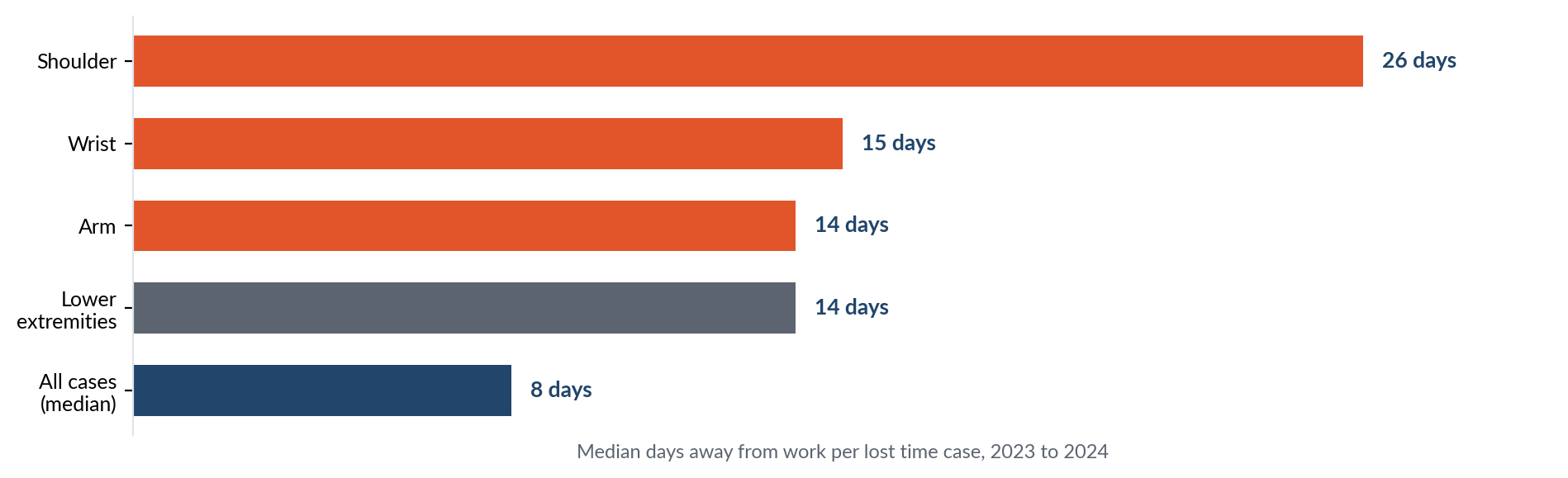
The mechanism is contact and struck-by. A tire lever or pry bar that slips off a bead, a bead breaker under load, a wheel weight hammered into place, a bare rim edge, a spinning wire wheel: each is an ordinary bay tool that becomes a laceration, a puncture, or a crushed finger the moment a hand slips. The all-case median is 8 days away from work per lost time case, and upper-extremity injuries run longer: a median of 15 days for the wrist, 26 for the shoulder.
03 · What about the part with no second chance?
The eyes: 2,000 a day,
and the mechanism.
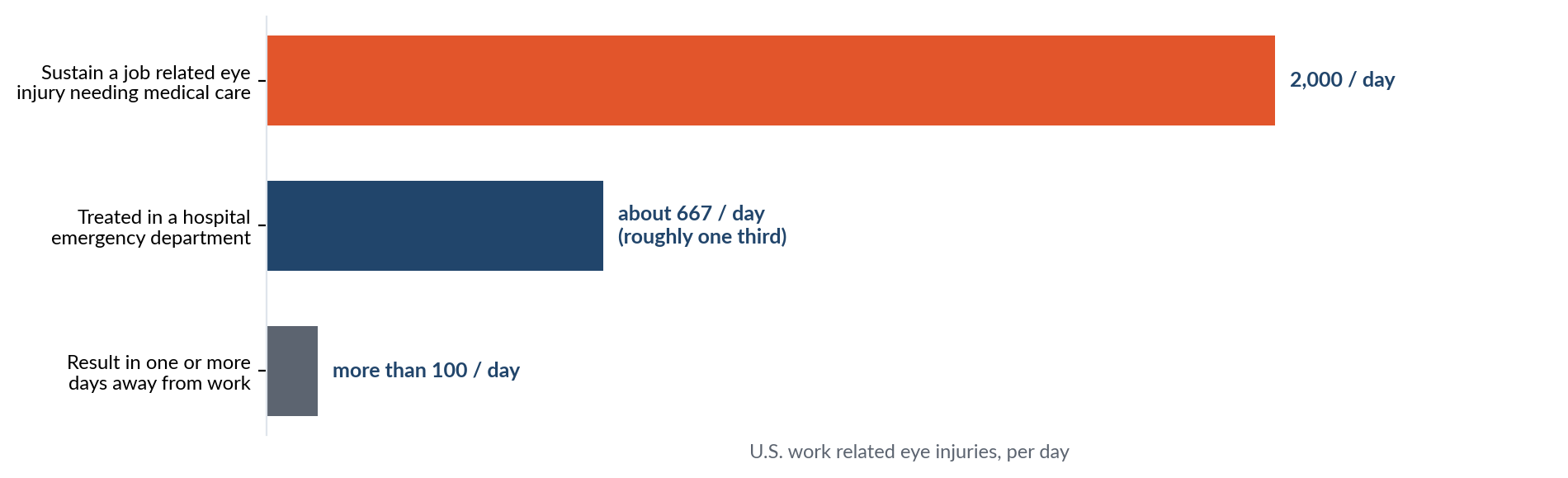
Roughly 2,000 U.S. workers a day sustain a job related eye injury that requires medical treatment, per NIOSH. About one third are treated in a hospital emergency department, and more than 100 a day result in one or more days away from work. The eye is the one body part with almost no repair margin: a scrape to a hand heals, a penetrating particle to an eye may not.
The mechanism matches the bay floor exactly. NIOSH attributes the majority of eye injuries to small particles or objects striking or scraping the eye: dust, metal slivers, and chips, often ejected by a tool, windblown, or falling from above. That is a precise description of grinding a rim, wire-wheeling a hub, blowing out a bead seat, or working underneath a vehicle. Chemical splash from cleaners and solvents is the second mechanism.
04 · What does one injury actually cost?
Cheap to prevent,
expensive to treat.
The National Safety Council estimates the societal cost of a single medically consulted work injury at $48,000 in 2024, and the cost per U.S. worker, the output each worker has to generate just to offset work injuries, at $1,120. Total U.S. work injury cost reached $181.4 billion.
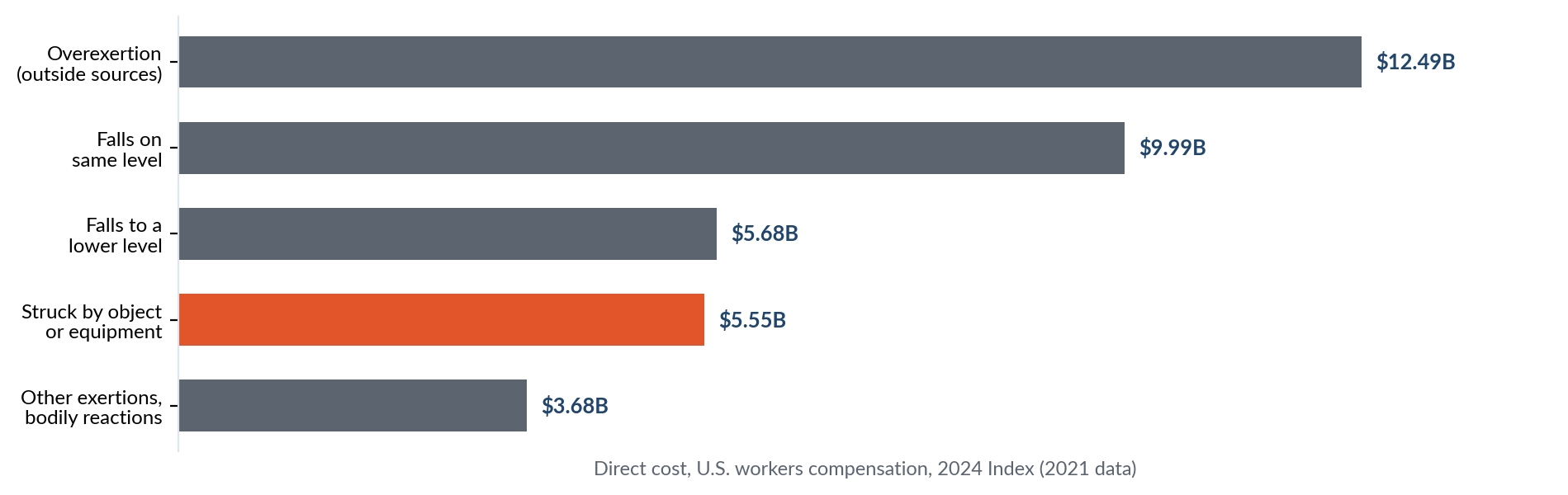
The employer-facing view comes from the Liberty Mutual Workplace Safety Index, which ranks the causes of serious injuries, the ones that cost more than five days of work, by workers compensation dollars. Struck by object or equipment, the exact hand and eye mechanism of the bay floor, is a persistent top-four driver, at $5.55 billion in the 2024 Index. In the most recent 2025 Index the top ten causes alone accounted for over 86% of all workplace injury cost, or $58.78 billion.
05 · Is the exposure rising or falling?
More miles, older cars,
more bay hours.
The number of hand and eye hours on American bay floors is rising, for reasons that have nothing to do with safety and everything to do with demand. The U.S. tire market reached an estimated $56 billion in 2025, replacement led. USTMA forecasts a record 338.9 million U.S. tire shipments in 2026. The fleet those tires mount to is the oldest ever recorded: 12.8 years across light vehicles, 14.5 for passenger cars, per S&P Global Mobility. Older cars do not defer tires, and the vehicle maintenance and repair line of the BLS Consumer Price Index is up 43.6% since 2019.
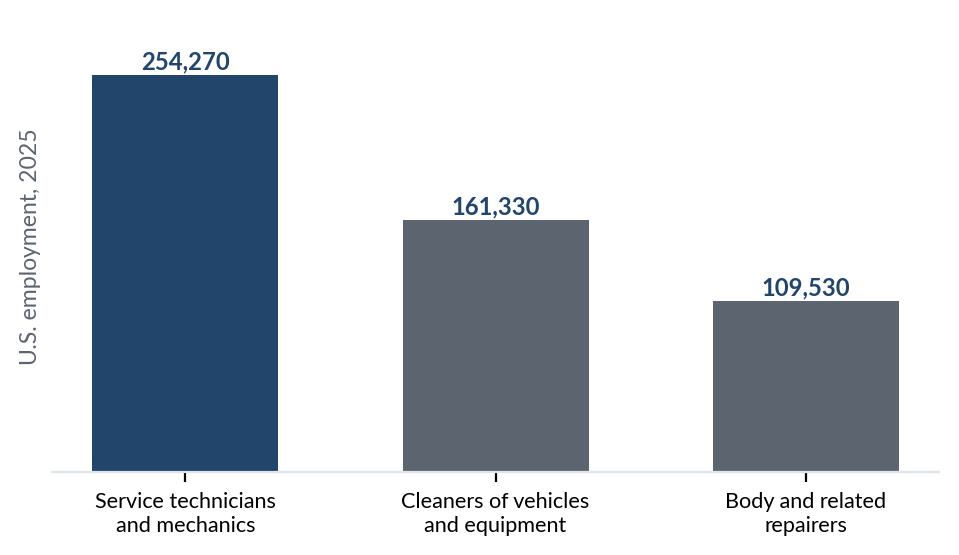
The people absorbing that exposure are a large, identifiable workforce: BLS counts 254,270 automotive service technicians and mechanics, 161,330 vehicle and equipment cleaners, and 109,530 body repairers. More than half a million pairs of hands and eyes, and the per-technician cost of protection looks smaller every year the fleet ages.
06 · What should a shop operator do this quarter?
Six moves. Low cost.
Tap to check off. Your list saves on this device.
- Run the hazard assessment.OSHA 1910.132 requires it before anything else: walk each station and write down where a hand or an eye meets a hazard. It is the document an inspector asks for first and the cheapest item on this list.
- Put ANSI Z87.1 eyewear on every bay, with side protection.1910.133 requires eye protection rated to ANSI Z87.1 with side shields wherever there is a flying-particle hazard. Stock it where the techs actually stand, not in a drawer in the office.
- Solve the fogging problem, or the glasses come off.The common failure is not missing eyewear, it is eyewear pushed up onto a forehead because it fogged. Anti-fog lenses are the difference between a policy and a habit.
- Cover the prescription-glasses technician.1910.133 specifically requires that a tech who wears prescription lenses gets protection that incorporates the prescription or fits over it. Safety readers, or a prescription safety-eyewear program, close this gap.
- Match hand protection and tool grip to the task.1910.138 requires gloves selected for the real hazard: cut, puncture, abrasion, chemical. On levers and bead breakers, a secure grip that keeps a hand from slipping off the tool prevents the struck-by injury before a glove has to.
- Document what you issued and when.A dated record of the hazard assessment, the equipment issued, and the training given is cheap insurance for any inspection, insurer question, or claim.
This checklist is general industry guidance, not legal, medical, or safety compliance advice.
07 · What would change this read?
Scenarios, alternatives,
and the falsifier.
Partial adoption
Eyewear is stocked but fogging and comfort drive it onto foreheads; gloves are inconsistent from station to station; grips are a personal preference. A predictable trickle of hand and eye lost-time cases continues, and each one dwarfs the small prevention cost it skipped.
Layered adoption
Hazard assessment done; anti-fog ANSI Z87.1 eyewear and task-matched gloves at every station; secure grips on levers and bead breakers; prescription-wearing techs covered. The struck-by and particle injuries in this report are largely designed out. The residual is overexertion, which is a different program.
Do nothing
Rely on be-careful and existing habits; treat protection as an expense to defer. Exposure tracks bay hours, which are rising with fleet age. The shop self-insures the injuries it declined to prevent, at $48,000 of societal cost per medically consulted case.
The alternatives, honestly. Before spending, a shop has real options other than buying protection: engineer the hazard out with guarding and better tools, train only, self-insure the risk, or do nothing. Layered protection plus a hazard assessment wins here not because it is the only path but because it is the cheapest marginal move for the two specific injuries the bay floor produces, and because OSHA already requires the core of it. Engineering controls are better where they exist, but nothing guards a rim chip out of an open eye.
08 · Take it with you
Publisher disclosure. CHAOS Supplies and CHAOS Moto, of Phoenix, Arizona, manufacture and supply shop safety products in the categories this report covers. That includes non-slip grips for tire levers and bead breakers, manufactured in the USA; ANSI Z87.1 rated anti-fog safety glasses; and a corporate prescription safety-eyewear program run through CHAOSRXOptics for shops that need to cover their prescription-wearing technicians under 1910.133. We publish the injury data and the OSHA duties straight because a shop that reads its own 300 log does not need to be sold, it needs to be equipped.
© 2026 CHAOS Supplies · Educational research, not legal, medical, or safety compliance advice · Questions or corrections: sales@chaosmoto.com · 480-829-7888 · Sharing with attribution welcome.