
CHAOS Moto · Comeback Economics Research · July 2026
Comeback
Economics
What a wheel-weight comeback actually costs a tire bay, built as a formula you can recompute with your own numbers, not a percentage we ask you to trust. Why weights fall off, according to the tape manufacturer's own guidance, and what an aging fleet means for how often you will find out.
01 · What is this report actually about?
The minutes nobody
adds up.
A wheel-weight comeback is not a big number. One redo is 15 to 20 minutes and a few cents of material. That is exactly why it survives on a shop's books unmeasured: no single instance is worth investigating, so the running total never gets added up. This report adds it up, using nothing but arithmetic anyone can check.
The formula is the one already published on CHAOS Moto's own comeback calculator: comebacks per week, minutes to fix each, and your shop's loaded labor rate multiply out to an annual number. We did not invent a multiplier or a percentage improvement to sell. The calculator's own copy says it plainly: "We are not going to promise you a percentage." This report extends that same honesty into a full walkthrough of the math, the mechanism, and the trend line.
The mechanism side is not speculation either. According to 3M's own published application guidelines for its wheel-weight system, adhesion failure traces to a short, specific list: incomplete wet-out, a contaminated wheel surface, a touched adhesive, a coating mismatch, or a temperature and condensation problem. Every item on that list is a process step, not a materials defect.
02 · What counts as a comeback, and what does not?
The narrow definition,
on purpose.
This report uses one specific definition: a comeback is a vehicle that returns to the bay because a wheel weight came off or moved after it left, and the fix is a rebalance, not a new tire, a new part, or a different repair. That is deliberately narrow. It excludes warranty tire replacements, alignment comebacks, TPMS resets, and every other reason a car returns to a shop. Widening the definition would widen the number, and this report is not interested in the biggest number it can construct, only the one it can defend.
Within that narrow definition, the redo itself is simple and short: pull the vehicle back in, remount the wheel on the balancer, spin it, locate the correction, clean and reattach a weight, spin again to confirm zero. There is no parts cost worth modeling and no diagnostic ambiguity. That simplicity is what makes the job formula-able instead of guess-able.
What this report does not do is claim a rate. It will not tell you that X% of wheel weights fall off, because no primary source publishes that number for the tire-service industry and this report is not going to manufacture one. What it will do is give you the cost of whatever your own rate turns out to be.
03 · Why does a wheel weight actually fail to hold?
A process problem,
according to the tape maker.
3M publishes application guidelines for its own wheel-weight system, and they read less like marketing and more like a checklist for a controlled industrial bonding process, because that is what attaching an adhesive wheel weight actually is. The guidelines specify a recommended application temperature range of 60 to 110F for both the wheel surface and the weight material, a minimum 80% tape wet-out with no localized voids, and roughly 5 psi of pressurization applied along the full length of the part.
The document's own troubleshooting section is the clearest evidence that failure is a process problem, not a materials one. It lists, in order: incomplete wet-out; surface contaminants on the wheel, specifically lubricants, skin oil, airborne dust, and tire-mounting lube residue; contaminants transferred to the tape itself when an operator touches the adhesive; a mismatch between the weight and the wheel's coating; and temperature or condensation, where a cold wheel or weight brought into a warm bay develops surface moisture that weakens short-term adhesion.
04 · What does one comeback actually cost, in a formula you can check?
The math: three lines
of arithmetic.
This is the same formula published on CHAOS Moto's live comeback calculator. Plug in your own three numbers and the rest follows; nothing here is estimated for you.
bay hours lost per year = (comebacks per year × minutes to fix each) ÷ 60
annual redo cost = bay hours lost per year × loaded shop labor rate
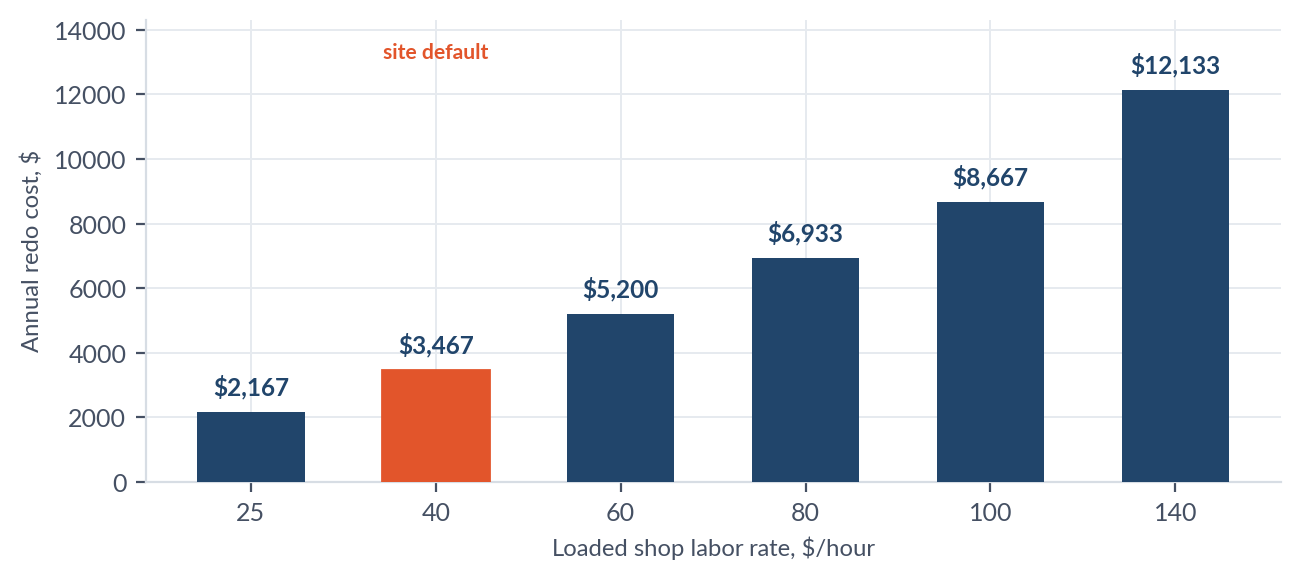
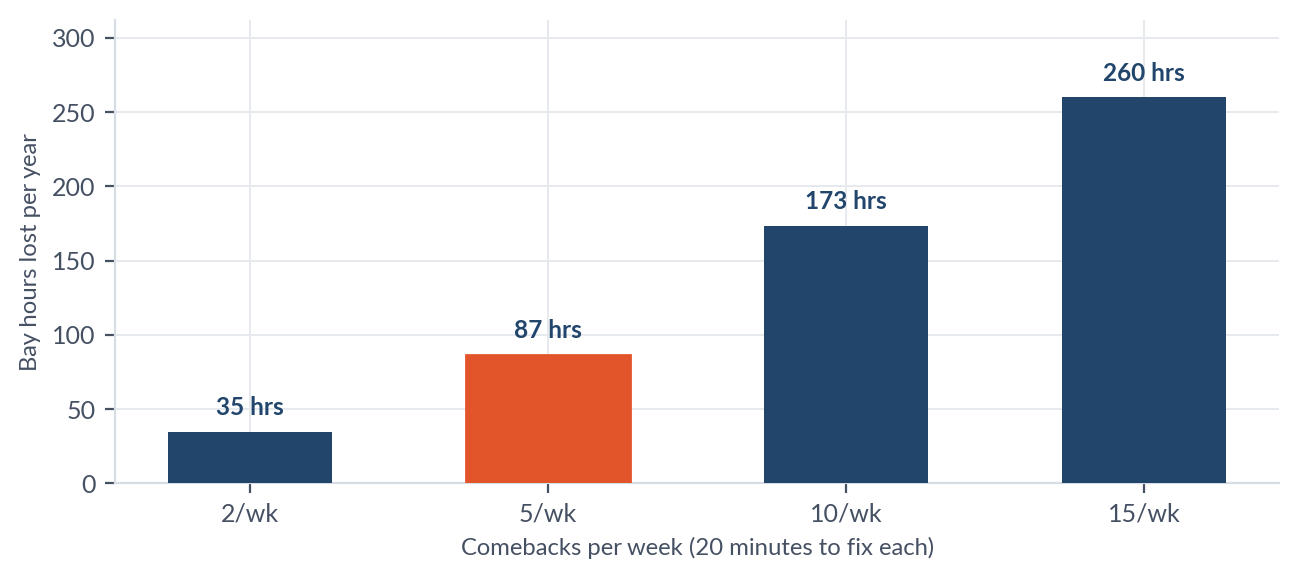
The calculator's own illustrative default, 5 comebacks a week and 20 minutes to fix each at a lean $40 loaded labor rate, works out to 260 comebacks, 87 bay hours, and $3,467 a year. That default is deliberately conservative: $40 an hour is closer to a technician's loaded wage than to a shop's posted labor rate, which the trade press puts at $120 to $159 an hour nationally in 2026.
05 · Is the exposure rising or falling?
An older fleet means
more balance jobs, not fewer.
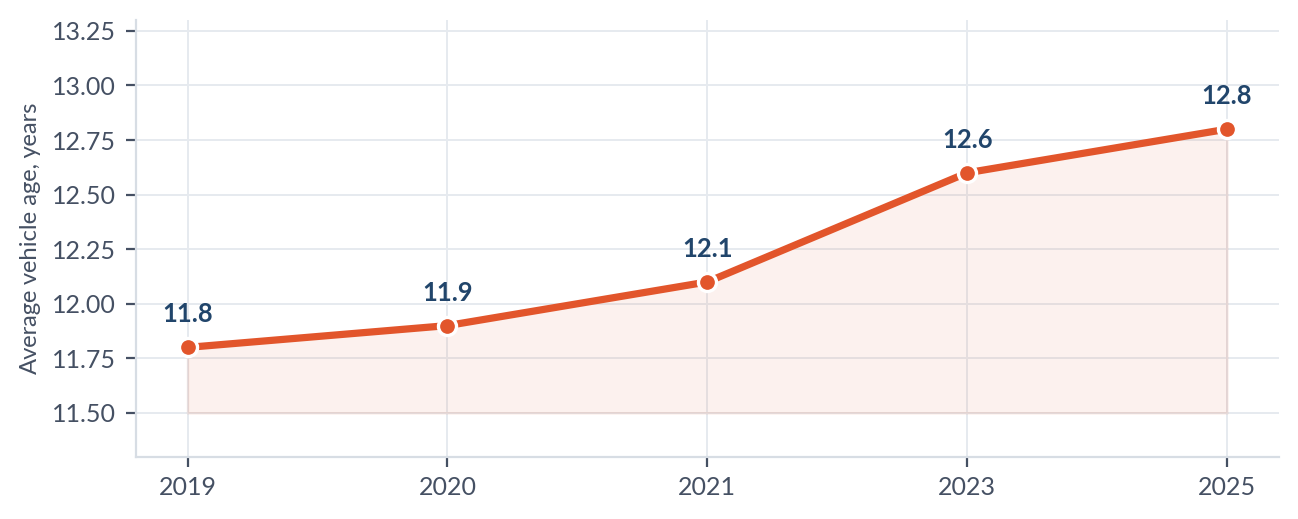
The number of wheel-balance jobs a shop performs is not a fixed cost of doing business; it scales with tire volume, and tire volume is rising for a structural reason that has nothing to do with how well any shop preps a wheel. The U.S. fleet is the oldest it has been on record: average vehicle age has climbed every year since 2019, from 11.8 years to 12.8 in 2025, 14.5 for passenger cars specifically.
Older cars need more tire service, not less, and USTMA forecasts a record 338.9 million U.S. tire shipments in 2026. Every one of those tires gets mounted and balanced at least once, which means every one of them is a fresh opportunity for the failure mechanism on the previous page.
06 · What should a shop operator do this quarter?
Six moves, straight from
the tape guidelines. Tap to check off. Your list saves on this device.
- Clean the mounting surface every time, not just when it looks dirty.3M's own guidance names dust, brake residue, and tire lube as adhesion killers you often cannot see. Treat cleaning as a step in the process, not a judgment call.
- Let the surface actually dry before the weight goes on.The guidelines call for adequate dry time after cleaning. A fast-evaporating cleaner shortens this step without skipping it; a slow one tempts a tech to skip it under time pressure.
- Do not touch the adhesive.Skin oil transfers to the tape the moment a finger brushes it. Pull the liner immediately before placement, not before.
- Pressurize the full length of the weight, not just the ends.3M's 80% minimum wet-out target is only reached with even pressure, roughly 5 psi, across the entire part.
- Watch the temperature, especially on a cold morning.Wheels or weights brought in from cold storage can develop condensation once they reach shop temperature. Let them equalize before applying.
- Count your own comebacks for one month before changing anything.Not an estimate, an actual tally: date, wheel position, and whether the weight was missing, loose, or migrated. That number, not a national average, is the one to run through the formula above.
This checklist reflects 3M's published application guidance for adhesive wheel weights in general. It is operational guidance, not a warranty or a guarantee against comebacks.
07 · What would change this read?
Scenarios, alternatives,
and the falsifier.
Uncounted
Comebacks happen at whatever rate they happen; nobody tallies them because each one is too small to investigate on its own. The annual total sits unmeasured on the books, absorbed into general shop inefficiency instead of being named as a specific, addressable cost.
Measured and prepped
One month of counting to find the real rate, then the six-step checklist run consistently: clean, dry, untouched, pressurized, temperature-checked. The comeback rate that count found becomes the baseline to beat, and the formula above turns any improvement into a dollar figure the shop can verify itself.
Chase a number instead
Adopt an industry-average comeback rate from a vendor claim and act on it without counting the shop's own. The action is aimed at a number that may not describe this shop at all. A shop with a low comeback rate wastes effort; a shop with a high one under-reacts.
The alternatives, honestly. Before touching the prep process, a shop has other levers: pass the rebalance cost to the customer as a paid redo instead of eating it, switch wheel-weight material or supplier entirely, or simply accept the current rate as a cost of doing business. Counting first and running the formula wins here not because prep discipline is the only fix, but because it is free to test for a month and the tape manufacturer's own troubleshooting order says the failure is preventable at the process level in most cases.
08 · Take it with you
Publisher disclosure. CHAOS Moto, of Phoenix, Arizona, manufactures Prep N Stick Quick Dry, a fast-evaporating, acetone-based wheel-prep cleaner formulated without TCE or perc. Its function is speed: it shortens the clean-and-dry step that 3M's own guidelines identify as a precondition for adhesion, without adding drying time back into a tech's redo-avoidance routine. It is flammable acetone (DOT UN1090, Class 3) and its claim here is limited to speed and being free of the two solvents EPA has moved to restrict; it is not marketed as safer to handle than any other wheel-prep product. We publish the calculator's formula and the manufacturer's own troubleshooting order because a shop that counts its own comebacks does not need to be sold a percentage, it needs a formula and a checklist.
© 2026 CHAOS Moto · Educational research, not financial or engineering advice · Questions or corrections: sales@chaosmoto.com · 480-829-7888 · Sharing with attribution welcome.