CHAOS Moto · Slow Leak and TPMS Research · July 2026
Chasing Air
Every light-duty vehicle built since September 2007 is required by federal law to warn its driver about low tire pressure. None of them is required to say where the air is going. This is what that gap means for the tire bay that has to find it: the mandate, the fleet data, the aging sensors, and the diagnosis time, as a formula you can recompute with your own numbers.
01 · What is this report actually about?
The lamp is federal.
The finding is yours.
A slow leak is the least dramatic problem in tire service. No blowout, no tow truck, just a tire that needs air every week or two and a dashboard lamp that will not stay off. That lamp is the product of a federal mandate, FMVSS No. 138, and it has one job: detect pressure 25% or more below the placard number and warn the driver. Finding the leak is not its job. Finding the leak is yours.
This report connects three sets of federal data that rarely get read together. First, the mandate history: why the lamp exists at all. Second, the fleet surveys: how much low pressure is actually rolling around out there, before and after TPMS. Third, the 2024 NHTSA study of TPMS outage and repair costs: what happens at the service counter as the monitoring hardware itself ages, fails, and gets quoted for repair.
Then it does what the other CHAOS reports do: turns the finding into arithmetic a shop can check. The diagnosis-time model here is the same formula already live on CHAOS Moto's leak calculator, with every input labeled and adjustable. We are not going to promise you a percentage. We are going to show you where the minutes go.
02 · Why does every car since 2007 nag its driver about tire pressure?
A recall crisis becomes
a dashboard lamp.
TPMS did not arrive as a convenience feature. It arrived as Section 13 of the TREAD Act, the law Congress passed in November 2000 in the wake of the Firestone recall hearings, ordering the Department of Transportation to require a warning system for significantly underinflated tires. The rulemaking took five years and one trip through the federal courts to settle what "significantly" means and how many tires the system must actually watch.
Tap any entry to expand it
- NOV 2000TREAD Act enactedSection 13 orders a rulemaking for a system that warns the operator when a tire is significantly underinflated.
- AUG 2003Second Circuit vacates the first standardThe Act unambiguously requires monitoring each tire, up to all four, not just some. NHTSA goes back to the drawing board.
- APR 2005FMVSS No. 138 final ruleTPMS must detect when any tire, in any combination up to all four, is 25% or more below the manufacturer's placard pressure and light a telltale.
- 2005-2007Phase-in20% of light vehicles from October 2005, 70% from September 2006.
- SEP 1, 2007Every new light vehicle must have TPMSNo carry-forward credits. Every light-duty vehicle sold new in the United States since carries the lamp.
- DEC 2015FAST Act closes the disable loopholeFMVSS 138 is directed to be amended so a TPMS cannot be overridden, reset, or recalibrated in a way that prevents it from detecting a significantly underinflated tire.
- NOV 2024NHTSA publishes the field studyDOT HS 813 617: how the mandated hardware is actually holding up. Outage rates, repair costs, and driver behavior, surveyed 2016 to 2018.
03 · Did the mandate actually fix underinflation?
Partly. That is the honest answer,
and the interesting one.
The case for TPMS working: NHTSA's 2010/2011 special study measured all four tires on thousands of vehicles and found 23.1% of MY 2004-07 vehicles without TPMS had at least one severely underinflated tire, against 11.8% of the same model years with TPMS. That is the source of the agency's estimate that TPMS cut the likelihood of severe underinflation by 55.6%. Newer TPMS vehicles did better still, at 5.7%. The lamp works.
The case that the problem survived the mandate: the same survey found 71.1% of MY 2004-2011 passenger vehicles running at least one tire a psi or more low, and 12.4% running at least one tire severely low, mandate and all. By NHTSA's 2018 field survey, 8.3% of vehicles on the road had the low-pressure telltale actually lit while being driven, and almost 13% had either a lit telltale or a TPMS that was not functioning. Millions of drivers are commuting behind a warning they have already decided to live with.
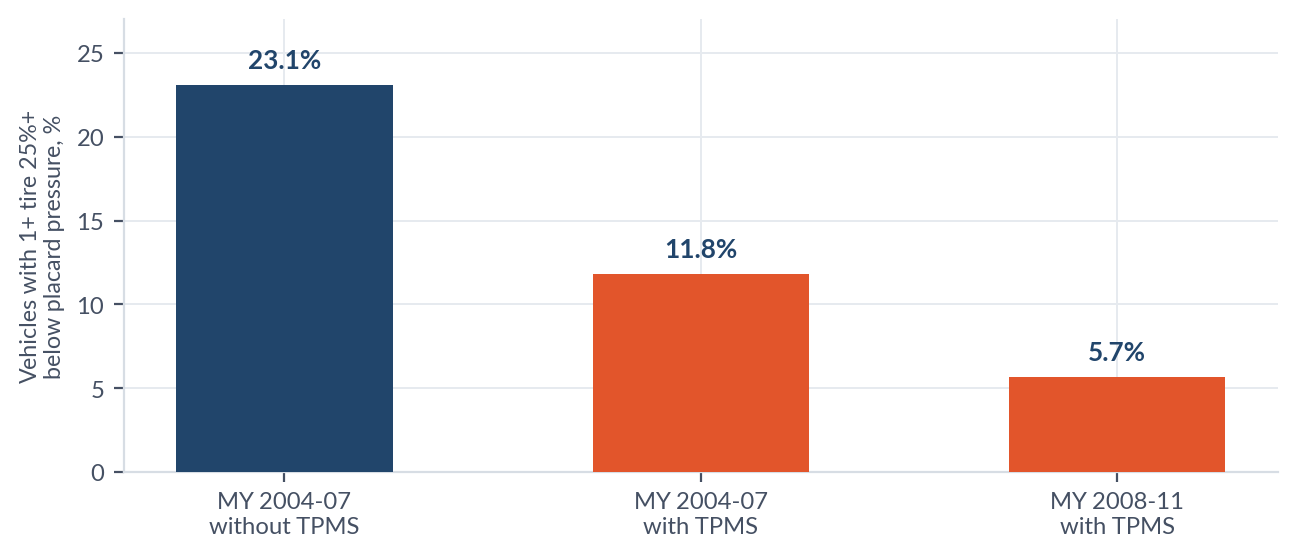
Both findings matter to a tire shop, because together they describe the demand stream: TPMS converted silent underinflation into an explicit, recurring, federally mandated prompt to get the tire looked at, while leaving the actual looking exactly as manual as it was in 1999. In 2001, before the mandate, 27% of passenger cars and 32% of light trucks were running 8+ psi low (NHTSA, 11,530 vehicles surveyed).
04 · What happens when the watchman itself gets old?
The aging-sensor economy
at the service counter.
The monitoring hardware is a wear item. Repair facilities surveyed by NHTSA put the median functional life of a tire pressure sensor at 5 years and a direct TPMS as a system at 4 years before it needs service; the most-cited failure cause is the worn-out sensor battery, named by over half of facilities, and sensors in general account for over 80% of direct-TPMS malfunctions shops see. Set those lifespans against a fleet whose average vehicle is now 12.8 years old and the arithmetic is plain: a large share of the mandated monitoring fleet is running on borrowed time, and the share grows every year the fleet ages.
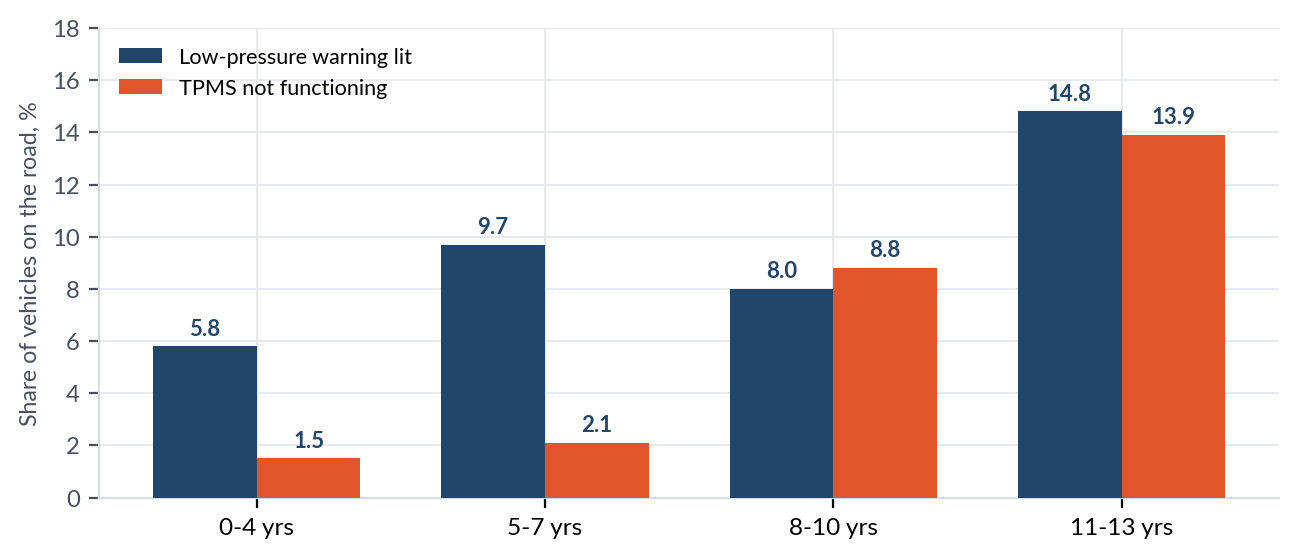
The field data shows exactly that. In vehicles up to 4 years old, 1.5% had a TPMS that was not functioning; by 11 to 13 years old, 13.9% did, with another 14.8% showing a lit low-pressure warning. And when the repair conversation happens, it goes badly: the typical charge is about $99 for one sensor, around $400 for a set of four, while under 2% of drivers say they would spend more than $300 on a TPMS repair. Four in ten facilities say drivers sometimes or frequently ask to disable the system or leave it broken, and the reason cited most, by 73%, is that the repair costs too much.
05 · What does a lit lamp cost the bay to resolve?
The chase, as three lines
of arithmetic.
A lit telltale walks in the door as a diagnosis job with two branches. Branch one: the pressure is genuinely low and something is leaking at the bead, the valve, the stem core, or a puncture, and someone has to find where. Branch two: the pressure is fine and the system itself has failed, usually a sensor battery. The intake takes seconds; the finding is where the minutes go, and the old ways of finding, the dunk tank and the soapy spray bottle, are the slowest station in the lane.
The cost model is the same formula already live on CHAOS Moto's leak calculator, reproduced here so the report and the calculator can never disagree. Three labeled inputs, no industry average pretending to be your shop:
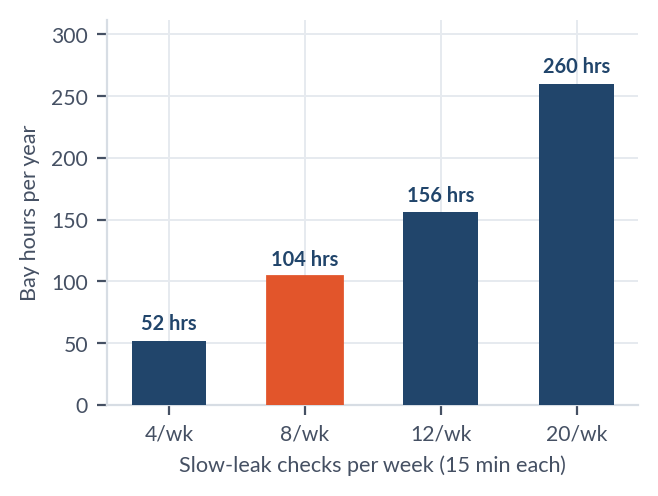
bay hours per year = (checks per year x minutes to find each) / 60
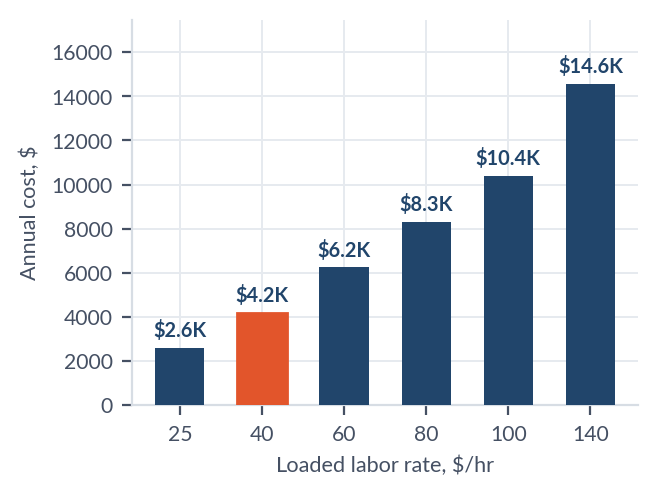
annual diagnosis cost = bay hours x loaded labor rate x locations
The calculator's illustrative default, 8 slow-leak checks a week at 15 minutes each and a lean $40 loaded rate, works out to 416 checks, 104 bay hours, and $4,160 a year, per location, in diagnosis time alone. It counts no dunk-tank upkeep and no comeback from the leak that got missed. Every input slides: your rate, your volume, your minutes.
06 · Is this demand stream growing or shrinking?
Older fleet, record shipments,
pricier labor.
Three structural lines all point the same direction. The fleet is the oldest on record at 12.8 years average, 14.5 for passenger cars, and NHTSA's own surveys find low pressure more often in older vehicles, with both warning types climbing steeply after year eight. USTMA forecasts a record 338.9 million U.S. tire shipments in 2026, and every mounted tire is a future pressure event: a bead that seats imperfectly, a valve that ages, a sensor that crosses its fifth birthday. And the labor to chase any of it has repriced: the CPI for vehicle maintenance and repair is up 43.6% since 2019.
The safety backdrop is not abstract either. NTSB counted about 33,000 tire-related passenger vehicle crashes a year, causing about 19,000 injuries, when it examined tire safety in 2015, and NHTSA counts 511 deaths on the road in tire-related crashes in 2024. NHTSA's own consumer data says only 19 percent of drivers keep their tires properly inflated. A shop that treats slow-leak diagnosis as a nuisance is underpricing both the minutes and the stakes.
Sized honestly: this sits inside the roughly $56 billion U.S. tire market, replacement led, not the $435 billion general aftermarket that gets quoted when someone wants a bigger number. The slow-leak lane is a small, permanent, federally prompted slice of that market, and it compounds with fleet age.
07 · What should a service desk do with all this, starting Monday?
The slow-leak intake checklist.
Six steps. Tap to check off. Your list saves on this device.
- Read the placard, not the sidewall.About a third of drivers look at the tire sidewall for recommended pressure; the sidewall is the maximum, the door-jamb placard is the spec. Set pressure to placard at intake, every time, and say the number out loud to the customer.
- Sort the lamp before touching the tire.A telltale at ignition-on that stays solid is a pressure event; a flashing or persistent malfunction sequence is a system event. Sixty seconds at the ignition sorts a leak job from a sensor job.
- Find the leak with a method that shows you the spot.Bead, valve, stem core, sidewall, puncture: the fix differs by location, so the diagnosis has to produce a location, not just a confirmation that air is leaving. Time whatever method you use; that number feeds the formula above.
- Quote sensor age at every tire replacement.Median sensor life is 5 years and the battery is not replaceable on most units. A sensor quoted while the tire is already off costs the customer one mounting; the same sensor quoted a month later costs two.
- Refuse the disable request with the standard, not an argument.Four in ten shops hear it. FMVSS 138, as amended after the FAST Act, is written so the system cannot legally be made non-detecting. Keep a one-line version at the counter: federal standard, not store policy.
- Log one month of slow-leak checks: count, minutes, and where the leak was.Then run your own three numbers through the calculator instead of trusting our default. Whatever the total says, it is currently being spent unmeasured.
Operational guidance reflecting NHTSA survey findings and the federal standard's text. It is not legal advice; state inspection rules vary, and a shop's counsel or state association is the right source for jurisdiction-specific questions.
08 · What would change this read?
Scenarios, alternatives,
and the falsifier.
Unmeasured
Slow-leak checks get absorbed as favors and the dunk tank keeps its corner of the bay. TPMS complaints are handled ad hoc; sensor quotes happen after the tire is back on the car. The diagnosis minutes stay invisible on the books, the sensor conversation stays adversarial, and the shop keeps paying the formula above without ever seeing the total.
Measured intake
The six-step intake runs on every pressure complaint: lamp sorted at the ignition, leak located visually, sensor age quoted with the tire off, one month of counting. The chase gets a number, the number gets managed down, and the TPMS lane turns from a nuisance into a priced service with a script at the counter.
Sensor upsell
The shop treats the aging-sensor data as a mandate to push four-corner sensor replacement on every car past year five, regardless of symptoms. Under 2% of drivers will pay more than $300 for TPMS work. Push past that ceiling without a lit lamp to point at and the customer hears upsell, asks for the disable you cannot legally perform, and takes the next set of tires elsewhere.
The alternatives, honestly. A shop has real options besides changing its leak-finding method: keep the dunk tank and accept its footprint and minutes; run soapy water from a spray bottle, which is nearly free and adequate at low volume; buy an electronic leak detector; or decline slow-leak diagnosis and send it down the street. Measuring first wins not because any one tool is magic but because the count is free, takes a month, and tells you which of those options your volume actually justifies.
09 · Take it with you
Publisher disclosure. CHAOS Moto, of Phoenix, Arizona, manufactures Bubble Check, a spray-on tire leak detector: a water-based surfactant formula applied at the bead, valve, or sidewall that bubbles at the leak point, with no dunk tank required. The largest independent tire retailer in the country uses it. We publish this research because a shop that counts its own slow-leak minutes does not need to be sold a percentage; it needs the federal data, a formula, and a stopwatch. Our commercial interest is exactly what it looks like: if the count persuades you the chase is expensive, we would like the chance to be the faster method you time against the old one.
© 2026 CHAOS Moto · Educational research, not legal, financial, or engineering advice · Questions or corrections: sales@chaosmoto.com · 480-829-7888 · Sharing with attribution welcome.