
CHAOS Supplies · Industry Research · July 2026
The Chlorinated
Solvent Exit
TCE, perc, and the new chemistry of wheel service. What two EPA rules finalized thirty days apart mean for every tire bay in America, what the courts have and have not changed, and the compliance clock your suppliers are already on.
01 · What happened, in one page?
Two rules, one exit.
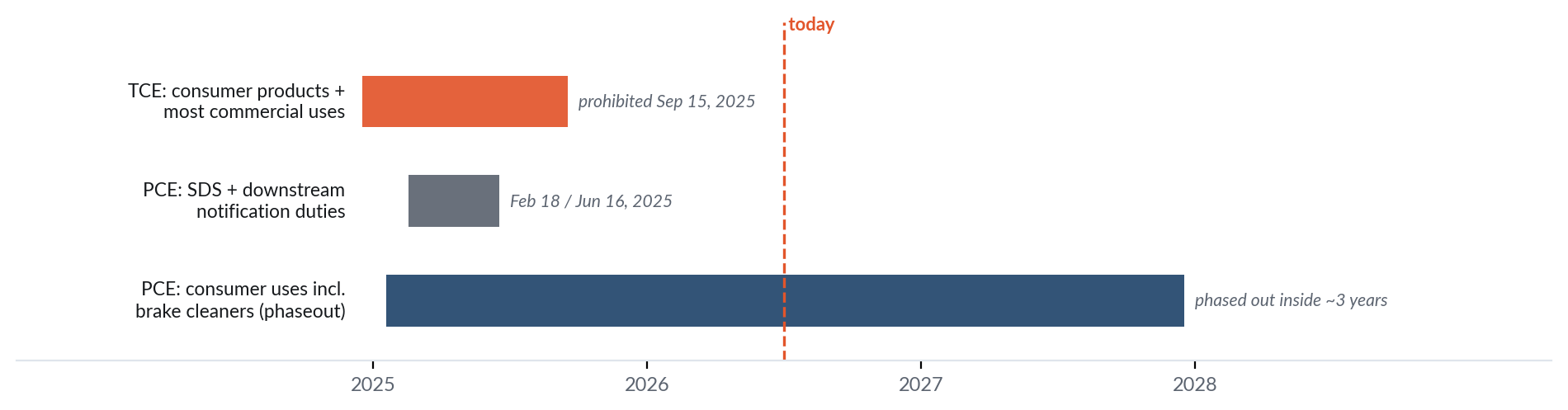
In December 2024 the EPA finalized risk management rules under the Toxic Substances Control Act for the two chlorinated solvents that quietly ran American wheel service for decades: trichloroethylene (TCE) on December 17, and perchloroethylene (PCE, "perc") on December 18. TCE is a known human carcinogen; the rule prohibits all uses. PCE, long the base of classic nonflammable brake cleaners, loses every consumer use and many commercial ones inside a roughly three year window.
Industry petitions put the TCE rule in front of the federal courts within a month. What survived matters more than the headlines: the core prohibitions took effect on schedule, and the litigation now argues the edges, not the center.
For a tire shop the practical consequence is simple: the legitimate supply chain for TCE based products is gone, and the perc based aerosol on the parts washer shelf is on a countdown. The question is no longer whether to change wheel prep chemistry. It is whether the change happens on the shop's schedule or the supply chain's.
02 · What does the TCE rule prohibit, and what did the courts change?
Banned at the center,
argued at the edges.
- Dec 17, 2024Final TCE rule issuedAll uses prohibited, most by September 15, 2025: consumer products and most commercial uses, degreasers and adhesion prep included.
- Jan 13, 2025Fifth Circuit grants a temporary stayHalf the industry heard "stayed" and stopped listening. The stay lasted ten weeks.
- Mar 28, 2025Third Circuit lifts the stayEverything live except the section 6(g) exemption conditions, which affect a handful of industrial users, not tire shops.
- Sep 15, 2025Core prohibitions in effectThe compliance date arrived on schedule.
- Feb 11, 2026Court declines to pause the rule againIndustry stay motions dismissed as unripe; the case moves to briefing on the merits with the prohibitions standing.
- Jul 2026TodayProhibitions in force. Exemption conditions postponed pending the litigation. Nothing in the sequence restores TCE to a parts shelf.
03 · Why is brake cleaner the next product to change?
The incumbent chemistry
gets a countdown.
One day after the TCE rule, the EPA finalized its PCE rule, effective January 17, 2025. PCE is the solvent that made classic "nonflammable" brake cleaner possible, and brake cleaner is the default wheel prep fluid in thousands of bays, a job it was never designed for. The rule bans all PCE consumer uses and many commercial and industrial uses inside a roughly three year window, with a 0.1% concentration threshold below which products fall outside the rule.
The early obligations were paperwork with teeth: safety data sheets had to carry the required PCE language by February 18, 2025 for manufacturers and June 16, 2025 for processors and distributors, and anyone shipping PCE has owed downstream notification since February 2025. That is why the labels on familiar aerosols started changing before the products did.
04 · What actually changes at the wheel?
Three chemistry families,
three tradeoffs.
Wheel weight adhesion prep needs a solvent that cuts brake dust and road film, flashes off fast, and leaves nothing behind. TCE and perc did that while being nonflammable, which is why they persisted. Each replacement family keeps two of the three virtues and surrenders one:
Acetone based
KeepsSpeed, residue free flash off, cutting power.
SurrendersNonflammability: acetone is DOT Class 3, and handling rules apply.
Outside both rules; no chlorinated content.
Water based, low VOC
KeepsNonflammable, mildest hazard profile on the shelf.
SurrendersDry time: water evaporates on its own schedule.
Outside both rules.
Legacy chlorinated
KeepsThe old performance profile, while remaining stock lasts.
ExitingTCE prohibited now; PCE consumer uses phasing out under the 2024 rules.
05 · How big is the machine these rules just reached into?
Record volume,
oldest fleet ever recorded.
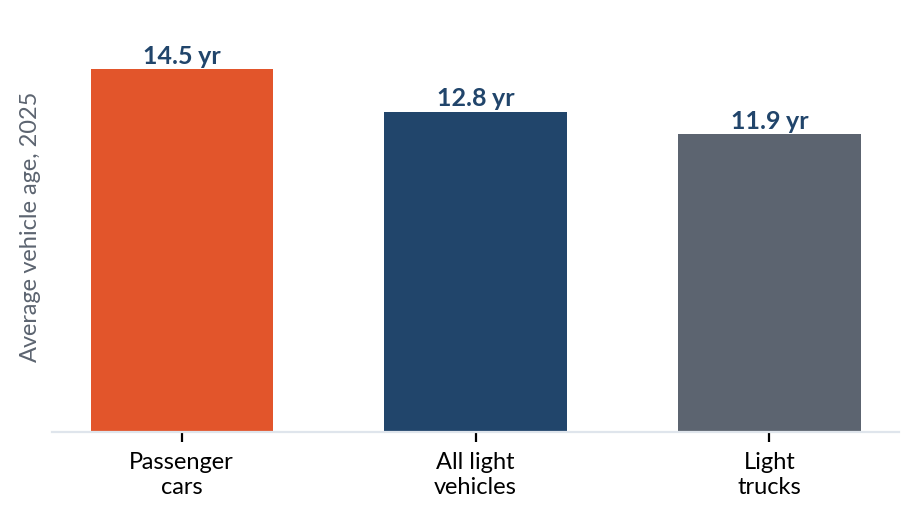
The rules land on a tire service industry running at record throughput: a $56 billion U.S. tire market in 2025, replacement led; a record 338.9 million U.S. tire shipments forecast for 2026 per USTMA; a fleet averaging 12.8 years across light vehicles, 14.5 for passenger cars, per S&P Global Mobility. Old fleets defer paint and upholstery; they do not defer tires. Maintenance and repair prices have outrun general inflation, up 43.6% since 2019 per the BLS Consumer Price Index.
The collision of those two curves is the actual story: maximum demand for the job at the precise moment the default fluids for the job leave the shelf. Markets in that shape reward whoever makes the transition boring.
06 · What should a shop operator do this quarter?
Six moves. None of them expensive.
Tap to check off. Your list saves on this device.
- Audit the shelf.Pull the SDS for every solvent, degreaser, and brake cleaner in the building. Search section 3 for trichloroethylene (CAS 79-01-6) and perchloroethylene (CAS 127-18-4). TCE product should already be out of service; anything PCE based goes on a replacement plan.
- Ask suppliers the dated question.Not "is this compliant" but "what is your reformulation date and what replaces this SKU." Your distributor already knows.
- Match chemistry to workflow, not habit.Fast evaporating acetone prep where throughput is the constraint, with Class 3 handling in place; water based where dry time fits. Decide per station, not per shop.
- Stop prepping wheels with brake cleaner.It was always an off label habit; its base chemistry is now exiting. Wheel prep is a defined job that deserves a fluid designed for it.
- Train the one sentence version.Techs do not need the Federal Register; they need "the old cans are carcinogen chemistry that is now banned, here is what we use instead and why."
- Document the transition.A one page dated memo listing what was removed and what replaced it is cheap insurance for any inspection, insurer question, or customer audit.
This checklist is general industry guidance, not legal or regulatory advice.
07 · What would change this read?
Scenarios, and the falsifier.
Most likely
Third Circuit litigation runs its course; core TCE prohibitions stay in force; the PCE consumer phaseout proceeds inside its window; formulators complete the migration. Chlorinated stock disappears through attrition. Shops that planned see a line item change; shops that did not see stockouts and price spikes on remaining inventory.
The transition compresses
Major aerosol brands reformulate ahead of deadlines to simplify national SKUs; retail channels drop chlorinated lines early. The change lands in quarters, not years, and early movers set the standard workflow their competitors copy.
Timelines wobble at the margins
Litigation produces a partial remand on specific TCE provisions; exemption scope gets revisited; PCE commercial timelines shift on industrial edge cases. The consumer product exits, the SDS duties, and the direction of travel do not reverse. No scenario restores TCE to shelves.
08 · Take it with you
Publisher disclosure. CHAOS Supplies is a Phoenix, Arizona manufacturer and supplier of shop chemicals and safety products, including wheel weight adhesion cleaners that compete in the category this report covers. Our fast evaporating prep solvent is acetone based: free of TCE and free of perc, with none of the banned carcinogen chemistry, and it is flammable, Class 3, exactly as the tradeoff section says. We publish the tradeoffs because the fastest way to lose a shop's trust is to pretend chemistry has no physics.
© 2026 CHAOS Supplies · Educational research, not legal advice · Questions or corrections: sales@chaosmoto.com · 480-829-7888 · Sharing with attribution welcome.